
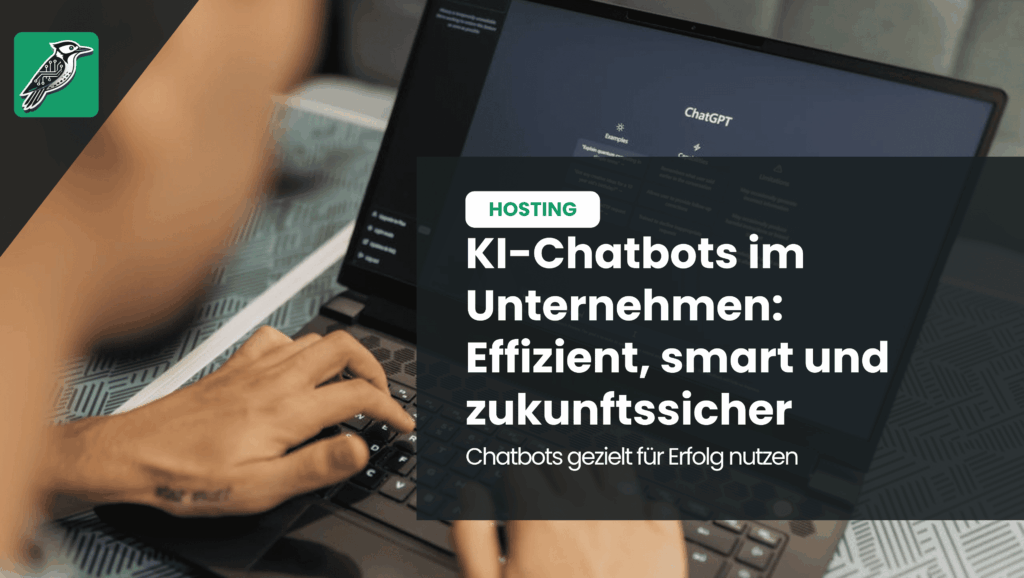
Chatbots for companies open up ground-breaking possibilities. In contrast to private chatbots, which can only be used via the chatbot provider, enterprise chatbots can be fully integrated into a company's existing IT landscape.
When you use a chatbot in your company, it's as if it were your own software. You adapt the chatbot to your processes, customers, systems, employees and other individual factors.
From now on, you will have a powerful assistant that will help you and your business to achieve greater efficiency and generally higher quality around the clock.
What is a company chatbot?
A company chatbot is software with which users can communicate. Communication usually takes place via a chat window. As part of the communication with the chatbot software, users issue prompts, whereupon the AI software performs tasks and delivers results.
Unlike conventional chatbots, the special chatbots for companies are more powerful, more secure and more feature-rich. And these are just some of the special qualities of enterprise chatbots.
With a specialized chatbot that is connected to other software and the company's entire IT, numerous processes in companies can be automated. Company chatbots are also synchronized with company data and can create real-time analyses.
In marketing, sales and other areas, chatbots contribute to a significant increase in efficiency and quality of results for companies.
A private chatbot, on the other hand, is limited to basic tasks that have to be entered into the chat window. The results then appear in the chat window. With a private chatbot, there is no question of process automation, a customer service application or the automatic creation of analyses and reports.
Use cases for chatbot software: What distinguishes AI-based chatbots for companies from private AI chatbots
A company chatbot differs from a conventional and privately used chatbot in the following aspects in particular:
- Targeted alignment with company processes
- Integration into the company's IT systems
- Higher security and data protection requirements
- Better scalability and adaptation to company growth
- Synchronization with internal data
Chatbot solution specialized in business processes
The ChatGPT version, which users can access and use free of charge on the Internet, is an example of an ordinary chatbot. This AI chatbot is already having a noticeably positive impact on everyday working life. Thanks to the delegation of research, writing and creative work to ChatGPT, employees save a lot of time.
In contrast to the basic version of ChatGPT, ChatGPT Enterprise and other AI chatbots for companies are specifically geared towards company processes. They can be used in customer service through customization to the use case and individual training.
Furthermore, corporate chatbots open up specific areas of application in lead generation and data analysis. For example, Excel spreadsheets with a wealth of data can be intelligently evaluated and automated reports sent to the relevant personnel.
Company chatbot: Software integrated into existing IT systems
In our article on the ChatGPT integration, we report on the integration of the ChatGPT chatbot into the company's existing systems. This integration makes AI-based chatbots part of the company's own digital infrastructure.
Being part of the company infrastructure opens up exciting possibilities. Initially, the chatbot software is connected to CRM and ERP systems via interfaces, for example. A connection to online marketing programs to evaluate sales figures in the online store or to create SEO reports is also conceivable.
As soon as the connection to other software is complete, the company chatbot no longer works in isolation and on instruction, unlike a conventional chatbot. As soon as new data is received in the ERP system, the AI chatbot can react to it around the clock. One example is the placement of new orders in the ERP system as soon as insufficient product stock is detected.
Chatbots only become really interesting for companies when they are implemented in the digital infrastructure: they manage product inventories, personnel matters, customer support and other processes, sometimes completely autonomously - depending on how much freedom a company gives its AI chatbot.
In any case, the integration of AI chatbots helps to maximize efficiency and relieve employees as much as possible. In addition, implementation in the existing system landscape is the key to automation. A private chatbot that is only called up via the browser and operated via an input field cannot lead to process automation.
Security and data protection: focus on compliance requirements for AI assistants
There are major data protection pitfalls, especially in automated data processing, if no corporate chatbot software is used. An ordinary chatbot does not even meet the basic requirements in terms of data protection.
AI chatbots in companies, on the other hand, are adapted to the high requirements of data protection. As a result, companies can use these chatbots in customer service. For example, ChatGPT Enterprise does not send any sensitive data to OpenAI in the USA.
Corporate chatbots adhere to compliance guidelines such as HIPAA or SOC 2 and meet IT security requirements.
The embedding in the company's existing IT systems alone provides increased cyber protection. Furthermore, the interfaces to chatbots and the chatbots themselves are secured by additional mechanisms. The prerequisite is, of course, that the implementation of AI chatbots is carried out by IT specialists.
Scalability of AI agents as a permanently optimal chatbot solution
Last but not least, the scalability and performance advantages of AI chatbots for companies should be emphasized. Unlike privately used chatbots, corporate AI agents can be scaled as required in terms of their computing capacity and other performance data.
For example, company chatbots process inquiries from various users. They guarantee responses in uptime. This makes corporate AI chatbots the ideal chatbot solution for customer messaging, as customers can make inquiries in several chats at the same time and the chatbot is definitely up to the task of dealing with this onslaught on customer service.
What's more, the user interfaces and other features of corporate AI chatbots can be customized. An AI assistant tailored to the corporate identity, for example, contributes to a better customer experience.
The possibilities for personalizing AI chatbots even extend so far that chatbots can learn from customer data and conversation histories in CRM systems how they should speak to customers.
In this way, the personalized chatbots promote human-like communication. This significantly increases the quality of customer service.
Synchronization with data: AI chatbots as a collection point for internal company knowledge
Collecting the company's own knowledge is extremely time-consuming without powerful AI chatbots. The reason is that all data must be stored in a structured manner in order to be easily retrievable. This results in an enormous amount of work.
By using AI chatbots, companies solve the challenge in an attractive way. Internal company data can be stored at will and completely unstructured. The chatbot software allows users easy access to the data they are looking for: Simply enter the query in the chat window and the chatbot will search for the desired information.
Business AI chatbots understand even complex requests without any problems. Instead of ordinary and isolated AI, enterprise chatbots use an advanced version of AI, Natural Language Processing (NLP) and Machine Learning (ML) to understand as many requests as possible.
The use of natural language processing and machine learning is also having a positive impact on customer support. In contrast to the first- and second-level chatbots that have been common for around a decade, AI chatbots are even able to process complex queries in third-level customer service thanks to their natural language understanding capabilities.
Examples of industries with AI chatbots: e-commerce and sales
AI chatbots are attractive all-in-one solutions, especially in e-commerce. If you want to create new subpages about individual products on your website, you can give ChatGPT or comparable chatbot tools the product data and the chatbots will create suitable texts. Then it continues as follows:
- The chatbot sorts results from SEO analyses and suggests new keywords for new subpages. In this way, it helps to improve website rankings on Google.
- As soon as customers come to the website, they want to find the products they are looking for quickly. This is where the chatbot comes in as all-in-one software. After attracting customers to the website with good content, the chatbot can show customers the right products on request.
- The chatbot software can also be trained to answer further questions from customers. For example, the AI chatbot can name the unique selling points of one product compared to another.
An all-in-one platform from a chatbot provider that is individually adapted to your own business takes a lot of the work off your website. It also noticeably reduces the workload on customer service.
Example of AI chatbot software in sales
In addition to e-commerce, there are also areas of application for chatbots in sales support.
For example, AI chatbots in sales can answer initial questions about an insurance product. In the course of this, the AI tools assess the degree of qualification of the leads - in other words, how high is the chance of turning the leads into paying customers?
At the end, the sales department receives a list of qualified leads that it can transform into paying customers.
If the success rate of the AI chatbot platform in sales is high and a conspicuously large number of leads can be successfully converted, further automation would be conceivable. The chatbot software could offer leads the option of booking an appointment with the relevant insurance broker directly in the chat window as part of a live chat function. This would save the broker from having to make a phone call to arrange an appointment.
Use of GPT-4 and successor models in editorial offices
Chatbots that have been individually optimized for online magazines and their IT systems have been used in editorial offices since version GPT-4.
DER SPIEGEL, for example, uses individualized chatbot software for customer service. As live chat software, the editorial team's artificial intelligence simplifies customer service. Chatbot software is also used for other purposes such as these:
- Generation of customer insights for interaction with editorial content
- Analysis of customer insights to uncover optimization potential
- Optimization of the customer experience by providing individual information and content based on analytical findings
The entire generation and analysis of insights is handled by the powerful chatbot solution, which can also perform various other tasks in addition to customer service in live chat. For example, AI chatbots at DER SPIEGEL magazine relieve the workload of several editorial departments and the marketing team.
Notes on the integration of an AI chatbot
Some companies develop their own chatbots entirely based on artificial intelligence. However, this is a cost-intensive undertaking, as many resources are required to train a large language model (LLM).
The easiest way to integrate an AI chatbot into your own business is to use a platform. Specht.ai's customers choose a specific AI chatbot platform in consultation with me after a personal consultation. You then don't have to develop your own chatbot software or anything like that.
Instead, they access the powerful basis of the chatbot provider. For a monthly fee, customers of an AI platform are provided with all the AI resources they need to customize and connect the AI chatbot to their own systems.
A professional service provider such as Specht.ai advises companies and supports them in seamlessly and efficiently integrating chatbot tools from a platform into their own systems.
Conclusion: Chatbots as an all-in-one solution for customer service, sales and other business applications
Ultimately, AI chatbots are completely customizable types of software. For a small fee, companies can book the use of a chatbot platform and adapt the AI tools on it to their business.
Thanks to AI technology, companies benefit from a significant boost in innovation and gain advantages over their competitors: more efficiency, more customer service, more data and insights.
The added value of a customized chatbot solution can be expressed in more than just quantitative terms. This is because, among other things, relieving employees and increasing their satisfaction provides companies with numerous non-monetary benefits.